
Wandsworth’s own Spending Review says the Government’s funding sums assume a 71% Band D rise over two years, and 230% if the council does nothing else.
The Government’s own funding sums for Wandsworth already assume the borough will put its council tax up by 71 per cent over the next two years. That figure is not a campaign claim. It is in the council’s own Spending Review, published as Paper No. 26-181 and considered by Cabinet on 29 July.
The same report puts a second, larger number on the record. If the council took no action at all to control its costs, it says, it “would be required to increase its share of Council Tax by 230%”.
Neither figure has been set. Both are projections in an initial report, and the council says it will publish the full package of measures later this year. But the report is the first document to show what the arithmetic looks like from inside the town hall.
The two numbers, and where they come from
Wandsworth has charged one of the lowest council taxes in England for decades. For 2026/27 the council’s own average share of a Band D bill is £517.70, up 2 per cent on last year, and the whole of that rise is the adult social care precept. The Greater London Authority adds £510.51. The average total Band D bill is £1,028.21, according to the council’s guide to council tax.
Against that base, the report sets out:
- 71 per cent. The Government’s calculation of Wandsworth’s transitional protection assumes the council raises council tax by 4.99 per cent plus £150 in each of 2027/28 and 2028/29. The report says this “would equate to a 71 per cent increase in Band D Council Tax in the short term”.
- 230 per cent. That 71 per cent only covers the loss of government grant. It does not close the underlying budget gap, which the report projects at £137m by 2028/29. Closing the whole gap through council tax alone would take a 230 per cent rise in the council’s share.
A rise above 5 per cent normally has to go to a local referendum. It will not here. The report says that as part of the Government’s offer to the six councils worst hit by the Fair Funding Review, it “proactively waived the referendum limit for 2027/28 and 2028/29 Council Tax setting”.
Why Wandsworth was hit hardest
The report traces the squeeze to the Fair Funding 2.0 review of December 2025, which changed how councils’ funding is worked out. Two changes did the damage.
The first reweighted the formula, playing down factors that matter most in inner London and adding a “remoteness adjustment” that helps rural areas. That cut the Government’s assessment of need in Wandsworth.
The second is the one that turns the borough’s low-tax record against it. The Government did not use what Wandsworth actually charges. It assumed a notional Band D rate set at the national average.
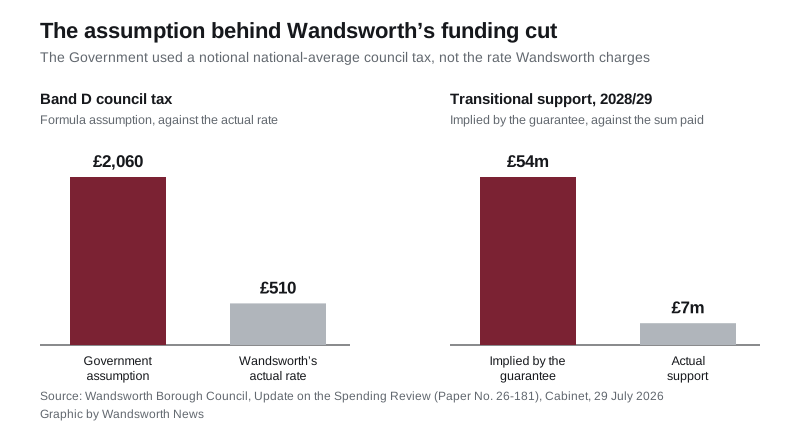
The Government chose to assume that Wandsworth’s Council Tax was set at £2,060 for Band D properties, compared to the actual rate of £510.
The report says the effect is that Wandsworth’s real revenue-raising power is “around a quarter” of the figure the Government used, and that the borough now faces “the largest cash reduction in funding in the country over the next three years”.
The transitional cushion shrinks for the same reason. Because the floor assumes Wandsworth will raise council tax well above 5 per cent, its transitional support works out at £7m a year in 2028/29 rather than the £54m the 95 per cent funding guarantee would otherwise imply.
In his foreword, Councillor Peter Graham, Deputy Leader and Cabinet Member for Finance, writes that “our funding has been slashed by 40 per cent” and that the Government treats the borough’s low tax “as a problem, not a positive”.
What else the report found
The funding cut lands on a budget that was already stretched. The report says:
- General Fund spending has grown by £188m since 2022, and inflation has added almost £100m to the budget each year.
- The council drew £15m from reserves to balance its 2025/26 budget. The 2026/27 budget assumes £48m.
- Reserves are “projected to run out in the next three years if urgent action isn’t taken”.
- Projected borrowing rises to £1.14 billion by 2035.
- Households in temporary accommodation have risen by more than 50 per cent since 2022, from 3,375 to more than 5,000.
- Adult social care client numbers are up 18 per cent, adding £32m a year in spend.
- The previous administration’s transformation programme had identified £14m of savings against a stated £45m target by May 2026.
What Cabinet has already cut
Cabinet did not only note the report. It agreed the first round of measures, recorded in the statement of decisions published on 30 July and in force from 5pm on 4 August unless called in.
The decisions were:
- Five schemes dropped from the council house-building programme: Ashburton Estate and Lennox Estate, on the administration’s manifesto commitment, plus Tyneham Close, Lavender Hill and Fitzhugh Estate, which the report calls “technically difficult to deliver”. Dropping them avoids about £77m of future housing borrowing and saves £5m a year in debt costs, against roughly £5.74m of abortive costs already incurred.
- The youth bus ends. It started in 2023 and costs £90,000 a year. The report says its equipment will be moved into youth centres.
- Bradstow School to be sold. The residential special school in Broadstairs, Kent closed in December 2025. Cabinet declared the land and buildings surplus and authorised disposal of the freehold, subject to any Secretary of State or Department for Education consent.
- The Leader’s Office is disbanded. The team of six full-time staff was set up by the previous administration.
- Three ringfenced pots opened up. The Cost of Living, Access for All and Borough of Sanctuary funds lose their ringfence, with remaining balances returned to reserves. A separate paper the same night returned a £6.2m Cost of Living Reserve balance and approved £2,084,500 to continue some of those projects in 2026/27 only.
The report also records an intention to fund extra police officers from developer contributions, with numbers still being discussed with the Metropolitan Police, and to consolidate council offices back onto the Town Hall campus.
Councillor Robert Morritt chaired the meeting. He was elected Leader of the Council at an extraordinary meeting of the full council on 22 July, which also appointed Councillor Graham as Deputy Leader.
What it means for you
Nothing on your bill changes this year. The 2026/27 charge is already set at £517.70 at Band D for the council’s share, and any change would take effect from April 2027.
The decisions that matter are in the diary now. A full review of the council’s capital programme goes to Cabinet in September, and the wider Medium Term Financial Strategy is due to be considered by members the same month. The report says the final Spending Review outcomes will “set out the actions the Council will take to reduce costs and limit the scale of any required Council Tax rise”, so the size of any increase depends on what those papers propose.
If you live on the Ashburton, Lennox or Fitzhugh estates, or near Tyneham Close or the Lavender Hill site, the new homes planned there are no longer in the programme. The report says other schemes in progress will be reviewed too, and that the council remains committed to delivering Block A on the Alton Estate within this council term.
Cabinet papers are published in advance at democracy.wandsworth.gov.uk, and decisions can be called in by the relevant scrutiny committee within five working days. You can also check what is happening near you on our Wandsworth planning page, and see what the market is doing on our house prices page.
Sources
- Wandsworth Borough Council, Update on the Spending Review, Paper No. 26-181, Cabinet, 29 July 2026
- Wandsworth Borough Council, Cabinet statement of decisions, 29 July 2026, published 30 July 2026
- Wandsworth Borough Council, Information on your Council Tax 2026/27
- Wandsworth Borough Council, Extraordinary meeting of the Council, 22 July 2026
Have your say