
Wandsworth says its GCSE results are the strongest yet but published no numbers. Here is what the last checkable year shows, and which schools did publish.
Wandsworth Council says the borough’s GCSE students have just recorded their best results yet. It has not published a single figure to show it.
Its statement on results day, Thursday 20 August, said early provisional results “indicate that Wandsworth’s students have achieved their strongest outcomes yet”. The improvements it named were in Attainment 8 and in “both English and maths benchmark measures”. The borough, it added, “continues to perform well above national averages”. (Wandsworth Council, 20 August)
No percentage, score or cohort size appears anywhere in it. Neither does a comparison year. That is a change from the council’s A level statement a week earlier, which gave borough figures for grades at A* to C and A* to E with the previous year alongside them.
The one number the council did give
The exception is its Virtual School, which supports children in care and previously looked-after children.
Nova Levine, headteacher of Wandsworth’s Virtual School, said the borough’s care-experienced Year 11 students achieved “provision results of 27% (Level 5s in both English and Maths) compared to CLA National 2024 of 7.9%”. CLA stands for children looked after. On the council’s own comparison, that is more than three times the national rate for the group.
That comparator is a 2024 one, so it does not tell you how this summer’s care-experienced cohort compares with this summer’s national picture. The Department for Education has not published the equivalent 2026 figure yet.
What can actually be checked
The last year for which Wandsworth’s GCSE performance exists as an official statistic is 2024/25, published by the Department for Education on 23 April 2026. The next edition, which will carry summer 2026, is due in October. (DfE, Key stage 4 performance)
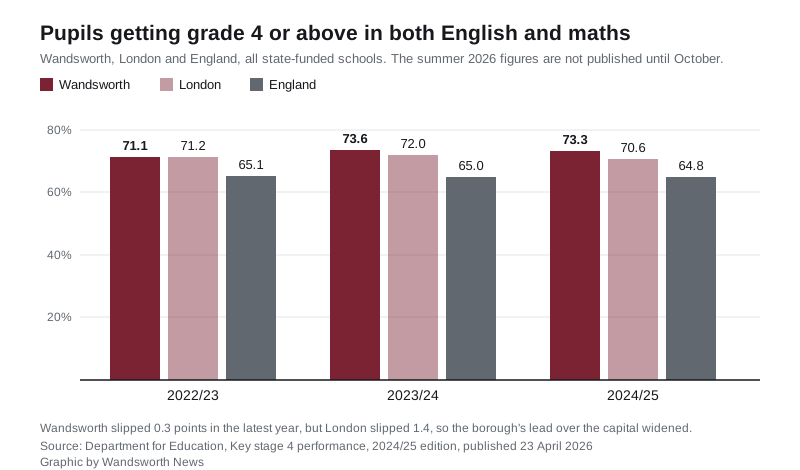
On that record, Wandsworth is comfortably ahead of both London and England:
| Measure, 2024/25 | Wandsworth | London | England |
|---|---|---|---|
| Grade 4+ in English and maths | 73.3% | 70.6% | 64.8% |
| Grade 5+ in English and maths | 57.1% | 52.9% | 45.4% |
| Average Attainment 8 score | 51.8 | 50.5 | 46.0 |
The three-year run is more interesting than the single year. Wandsworth’s grade 4+ figure went 71.1%, then 73.6%, then 73.3%. So the borough dipped by 0.3 points in the most recent published year. Its grade 5+ figure fell further, from 59.1% to 57.1%, and Attainment 8 edged down from 52.1 to 51.8.
London fell faster over the same year. The capital’s grade 4+ rate went from 72.0% to 70.6%, and its grade 5+ rate from 55.1% to 52.9%. Wandsworth was level with London in 2022/23 and is now 2.7 points ahead of it.
England moved barely at all: 65.1%, 65.0%, 64.8%.
The three schools that published their own figures
Most Wandsworth secondaries put out no numbers on the day. Three did.
- Chestnut Grove Academy, Balham: 36% of grades at 7 or above, 82% of students at grade 4 or above in English and maths, 65% at grade 5 or above, and an Attainment 8 score of 57.3. (Chestnut Grove Academy)
- Putney High School, the fee-charging GDST school on Putney Hill: 53% of grades at 9, 80% at 8 or 9, and 92% at 9 to 7, with more than one student in five achieving nine or more grade 9s. (Putney High School)
- Ibstock Place School, the independent school in Roehampton: 84% of grades at 9 to 7, with 100% of music grades and 93% of grades across maths, biology, chemistry and physics in that band. (Ibstock Place School)
Those three sets of figures are not comparable with each other. Chestnut Grove’s headline measures count students; Putney High’s and Ibstock’s count individual grades. Two of the three charge fees and select on academic ability. Reading them as a league table would tell you almost nothing about the schools and quite a lot about their admissions.
Burntwood School’s published results page still carries its 2025 summary. Ernest Bevin Academy, Graveney School, Emanuel School and Saint Cecilia’s had no 2026 GCSE figures on their own sites when we checked on 22 August. Southfields Academy’s news page and Ashcroft Academy’s examination results page did not load for us, so we cannot say either way for those two.
Why “above the national average” needs a second look
Every council says this on results day, and the national figure they reach for is usually the wrong one.
Ofqual’s summer 2026 statistics put 67.0% of all GCSE results in England at grade 4 or above. That figure covers everybody who sat a GCSE, including the large number of post-16 students resitting English and maths at college. Strip those out and look only at 16-year-olds and the England figure rises to 70.7%. (Ofqual, Qualification results in England summer 2026, tables 19a and 19b)
London is higher again. Across all ages, 71.7% of London results were at grade 4 or above and 28.6% at grade 7 or above. For 16-year-olds only, that becomes 75.5% and 30.2%, the strongest of any English region.
Ofqual’s centre-type table shows how much the kind of school drives the number. In summer 2026, results at grade 4 or above ran as follows:
- grammar schools 97.4%
- independent schools 88.4%
- local authority comprehensives 68.6%
- academies 68.2%
- all state-funded schools 66.1%
- sixth form colleges 32.2%
- further education establishments 17.6%
The bottom two are not failing institutions. They are resit centres, teaching students who did not reach grade 4 the first time.
There is one more limit worth knowing. Ofqual’s downloadable tables carry no local authority breakdown at all, for GCSE or A level. Its interactive map does, but it assigns results to areas by the postcode of the exam centre rather than by where the student lives. A district with a large selective or independent school therefore ranks high on other people’s children.
So any borough-level GCSE figure for summer 2026 has to come from the council or from the schools themselves. That is why the absence of one here matters.
What it means for you
If your child’s grade looks wrong, the route is through the school, not the exam board. Requests go via the centre’s exams officer and need the student’s written consent.
- Clerical re-check, which confirms the marks were added up and recorded correctly: deadline 24 September 2026, completed within 10 calendar days.
- Review of marking, a fuller check by a senior examiner: deadline 24 September 2026, completed within 20 calendar days.
- The priority service, which closed on 20 August, covers A level, T Level and Level 3 vocational qualifications only. It does not apply to GCSEs. (JCQ post-results services)
- There is no grade protection on a review. A grade can go down as well as up.
Students resitting English or maths in the autumn sit them in the first full week of November. On the Pearson Edexcel timetable, English Language Paper 1 is on Tuesday 3 November and Paper 2 on Thursday 5 November; maths papers fall on Wednesday 4, Friday 6 and Monday 9 November. All are morning sittings, and entries go through the school or college. (Pearson Edexcel, GCSE November 2026 timetable)
Wandsworth’s Post-16 Participation Team, its schools and its colleges all offer advice on next steps, and the Virtual School supports care-experienced students specifically.
Our report on the borough’s A level results this summer covers the Year 13 side of the same fortnight. Families weighing a move for a school place may also want our page on Wandsworth house prices.
Have your say