
Utility firms would pay £1,000 to £2,500 a day to dig up 80 stretches of Wandsworth road at busy times. See which roads, and comment by 13 November.
Utility companies would pay up to £2,500 a day to dig up Wandsworth’s busiest roads at peak times, under a scheme the council has put out to consultation. The charge would apply on 80 stretches of road, from Putney High Street and Garratt Lane to Northcote Road and Bedford Hill.
The proposed Lane Rental Scheme would cover 11.6% of the borough’s road network. Anyone can comment until 13 November 2026. The council would then need the Department for Transport’s approval before any charge applies. (Wandsworth Council, 23 October 2026)
How the charge would work
The idea is simple: make it expensive to block a busy road at a busy time. Work done outside the charged hours costs nothing extra. The council’s scheme document sets three bands for the carriageway:
| Band | Daily charge | Charged hours | Road sections |
|---|---|---|---|
| High | £2,500 | Weekdays 7am to 7pm; weekends 7am to 10am and 3pm to 7pm | 15 |
| Medium | £1,500 | 7am to 10am and 3pm to 7pm, every day | 18 |
| Low | £1,000 | 7am to 10am and 3pm to 7pm, every day | 47 |
The counts come from the council’s list of proposed locations. Some roads are split, so Putney Hill is High from Upper Richmond Road to Putney Heath and Medium beyond it.
Other points from the scheme document:
- The charge is per day, and it runs on Saturdays, Sundays and bank holidays too. Only Christmas Day is free.
- £2,500 a road a day is the current cap on any charge.
- The first 24 hours of a genuine emergency, where work is needed to avoid significant danger to the public or damage to property, are not charged.
- Two or more firms working on the same stretch at the same time can ask for the charge to be waived while they share the site.
- The council’s own road works would pay the charge as well.
- A firm that tries to clear a site but accidentally leaves up to five signs or barriers behind pays a one-off £100 instead of the full daily charge.
Which roads are in the top band
The 15 sections charged £2,500 a day are:
- Putney High Street, Putney Bridge, Putney Bridge Approach and Wandsworth Bridge
- Putney Bridge Road (Putney High Street to Oxford Road)
- Putney Hill (Upper Richmond Road to Putney Heath)
- Lower Richmond Road (Putney High Street to Bemish Road)
- Garratt Lane, Mitcham Road and Mitcham Lane (Thrale Road to the borough boundary)
- Lavender Hill, St John’s Hill, Queens Circus and Bridgend Road
- Queenstown Road (Chelsea Bridge to Ingate Place)
Buckhold Road, Falcon Road, Merton Road (Durnsford Road to Buckhold Road), St John’s Road and Albert Bridge Road are among the Medium roads. Northcote Road, Bedford Hill, Old York Road and Nightingale Lane are among the Low ones.
The borough’s red routes are not on the list. The A3 through the town centre, the South Circular and the A24 through Balham and Tooting are run by Transport for London, not the council.
Why the council wants it
The council says the charge would push companies to work at quieter times, finish faster and share holes with each other. Cllr Nick Austin, Cabinet Member for Transport, said roadworks “cause disruption for residents and businesses, so we want to reduce traffic congestion in our borough and hold utility companies to account.”
The council’s evaluation of its current permit scheme, published alongside the consultation, shows how much digging there is. Utility companies applied for 8,169 permits in 2024/25, and the council refused 24.7% of applications and variations that year, up from 19.9% in 2022/23. (London Permit Scheme evaluation report, April 2022 to March 2025)
It also shows more firms working without permission. Fines for working without a permit more than doubled in a year, from 127 to 289.
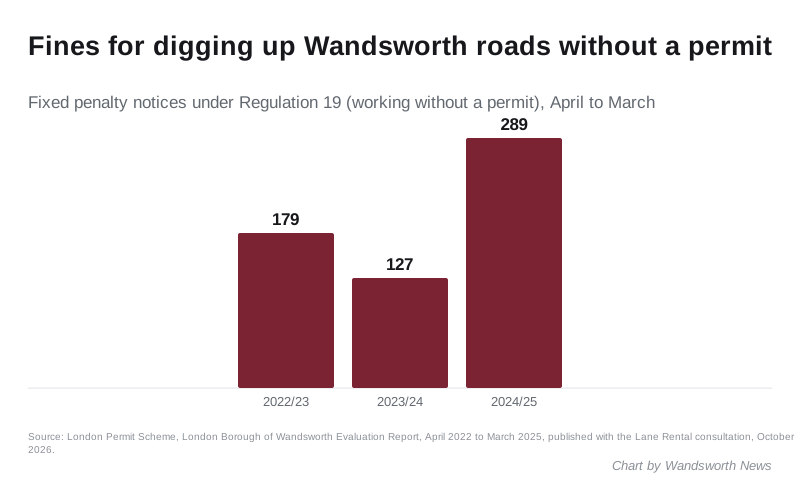
Other fines fell over the same period. Notices for breaking permit conditions dropped from 746 in 2023/24 to 320 in 2024/25.
When the council challenges how long an emergency job needs, it records the days of disruption saved. It issued 328 of those challenges in 2024/25 and says they saved 647 days.
Where the money would go
The council would first take its costs of running the scheme out of the charges. Government rules then require half of any surplus to be spent on road maintenance. The other half must go on reducing the disruption caused by street works. The council says it will publish guidance on how that money can be spent.
The consultation documents give no start date. If the Department for Transport approves the scheme, the council must give firms at least 12 weeks’ notice. A four-week trial with no real charges would follow.
What it means for you
If you drive, cycle or take the bus on these roads, the aim is fewer daytime lane closures and shorter jobs. This week’s roadworks show the kind of work that would be affected. Thames Water has signals booked outside 195 Garratt Lane on 29 and 30 October, and Garratt Lane would be a £2,500 road. This week’s closures are on our roadworks page.
If you live on one of these roads, more work could move to evenings and weekends, which is the point of the scheme. The weekend charge in the top band covers only the morning and early evening, so midday weekend work would cost nothing. Say so in the consultation if that worries you.
If you want a say, the online survey is open until 13 November. The council is especially keen to hear from utility companies, but anyone can respond. For a paper copy or another format, email Wandsworthlanerental@wandsworth.gov.uk or call 020 8871 6000.
If you want to see your street, the council has published a map of the scheme as well as the full list.
Sources
- Have your say on Wandsworth’s plan to reduce roadworks disruption (Wandsworth Council, 23 October 2026)
- Wandsworth Lane Rental Scheme Consultation (Citizen Space, opened 16 October, closes 13 November 2026)
- Proposed Lane Rental Locations, Timings and Charge Bands
- Lane Rental Scheme Document v2.1, consultation version, 12 September 2026
- London Permit Scheme, London Borough of Wandsworth Evaluation Report, April 2022 to March 2025
- Roadworks and Events Bulletin, week commencing 26 October 2026
Have your say